The Natural Bliss of Being – Jackson Peterson

For some,
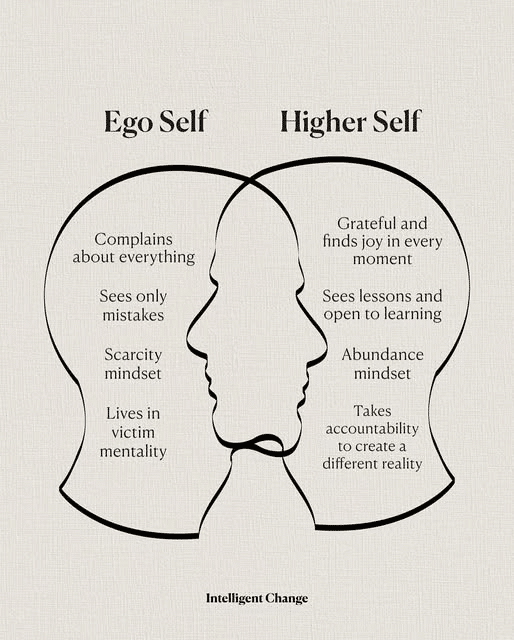
living in the emotional drama gives a stronger sense of identity
because it is so vividly present in those moments.
Though it is not a comfortable experience, it is yet self reinforcing.
But in certain cases the energized sense of identity
has more value to the mind than being free of the suffering.
That’s why some people thrive on turmoil and crisis.
They have greater certainty or feeling that they exist.
This could also be said of chronic self-pity,
in which there seems to be an enjoyment within the “poor me” dynamic.

Often unsuspecting customers buy a ticket to the “pity party”
and find themselves sucked into someone else’s needs for attention and validation.
It becomes a real pity party
when both start feeding off each other’s unhealthy emotional needs.
There are many ways that the ego structure
feeds off of negative emotional states and unhealthy relationships.
I recommend that you take stock of your own tendencies in this area of behavior.
None of us are immune from this type of self reinforcing dynamic,
at least not until our consciousness is no longer focused in ego-identity
and has discovered timeless beingness,
which requires no emotional reinforcement or validation.

By practicing being the objective observer
to the events that arise continuously in consciousness,
a new dynamic regarding the identification with this
mind-generated sense of self occurs.
Over time,
there is a new feature to the flow of ordinary consciousness:
the solidity of the self-projection diminishes.
The sense of self is no longer quite so convincing
nor are its problems so compelling and serious.
It is not that the imagined self is progressing through stages of improvement,
but it is more of a total dissolution of the imagined self.
This dissolution of the imaginary self
reveals the true nature of our beingness within,
the actual source of our intrinsic deep peace, joy, and unconditional love.
The true nature of our beingness is this
undefined and objective observing
that has no name, identity, or history.
It is always present within all experience.
Ego could be defined as whatever covers up basic goodness.
From an experiential point of view, what is ego covering up?
It’s covering up our experience of just being here,
just fully being where we are, so that we can relate with
the immediacy of our experience.

Egolessness is a state of mind that has complete confidence
in the sacredness of the world.
It is unconditional well-being, unconditional joy that includes
all the different qualities of our experience.
(Tibetan Buddhist teacher Pema Chodron)
In many ways, our daily state of mind is more akin to a trance
than consciously aware living.
That’s because the aspect of our mind that projects our dreams while sleeping
is also busy when we’re awake projecting endless mental scenarios
that oscillate between hope and fear.
A good example is our sense of self.
When dreaming
we have a role and identity in whatever the scenario happens to be.
We are not consciously creating this dream identity;
it just arises from the subconscious.
But it seems like who we really are in the dream.
The emotional states and thoughts we experience in the dream
are not questioned regarding their appropriateness and validity.
When we awake,
that dream identity vanishes,
but we fail to notice that the mind is still projecting our sense of self and self-image.
We don’t even question the appropriateness of our
emotional states, thoughts, or sense of self while awake.
It is easy to see why many spiritual masters of different spiritual traditions
have considered that mankind is asleep… even while awake.
This results in much of life’s unnecessary suffering.
We become lost in our stories,
which are often based on conditioned responses and imagination,
not the clarity of being vividly and alertly present to the current moment.
There’s a huge difference between the two.
We aspire to the latter as we wake up from the former.
It’s critical to discern between knowing who we actually are,
as opposed to believing a story about who we think we are.
In a dream we may suffer in many ways due to the drama in the story line.
The one who suffers is our sense of “me” in the dream.
If we only knew the entire story line was just an imaginary mental show,
it would not be possible to suffer due to the dream’s contents.
A primary aspect that is necessary in order to suffer within the dream
is to believe that the person you think you are in the dream is real.
The dreaming mind creates not only the scenery and people in the dream
but also a sense of personal subjectivity.
There is no real person or self there,
as the self is just a projection of the mind.
Likewise
the person you think you are in waking life is also a projection of mind
and is not real,
no more than Santa Claus or the Easter Bunny.
Both of these fictional characters take on great life in the minds of children.
But no matter how deeply and sincerely a child believes in Santa Claus,
it will never make this fictional character real.
Even so,
the child can be motivated to act in certain ways by belief in this fiction.
For example,
the child can try to be better behaved or more obedient to
“get presents from Santa.”
We need to develop this open state of mind
to effectively notice the arising and continuing presence of the me thought.
We discover that the me thought lies at the center of our
psychological and emotional experiences from moment to moment.
It’s all about me and my story.
The entire personal story revolves around me.
Because of this we have a sense of being a separate individual
living in a world of separate people as “others” existing “out there.”
This fundamental bifurcation of life experience into separate subjects and objects
creates a general sense of existential alienation from the wholeness of life.

We often feel alone and apart even though we may be
living in a rich social context of family and friends.
This is due to a personal story that revolves around
the imagined notion of being a separate me.
Over time this illusion becomes a default style of how we relate to ourselves
and our world of experience.
We may isolate ourselves further and further psychologically,
eventually leading to states of depression and suicide.
However,
when we feel connected as a meaningful part of the whole,
we flourish within our emotional lives.

Our entire society is me driven,
as represented in advertising that floods our consciousness daily.
The message that you need to consume endless products
is reinforced on many levels, and if you don’t consume the right products
you will somehow not be in the best social and personal position.
So you need a bigger car, a better house, stylish clothing and accoutrements,
plastic surgery, Botox, success seminars, and more,
all in the name of enhancing me.
At the same time,
along with the rise and establishment of today’s me culture,
we have a similar increase in mental illness, suicide, crime, family structure breakdown, environmental neglect and abuse, and a generation of young people who have no real sense of connection with their natural world other than through the Internet, computer games, and social-media networking.
From time to time notice that quality of aware observing that
perceives this sense of me as it arises in consciousness.
That observing awareness is the aspect of our consciousness
that needs to be at the forefront of our cognitive life,
not our sense of me and its conditioned reflexes.
When we reside in our authentic sense of undefined being as this
observing awareness, we are free to be everything,
in the sense of a panoramic inclusivity.
Our sense of self is no longer isolated from its world of experience;
on the contrary, .
the mind can no longer find a line of demarcation
separating it from its perceptions and relationships.
Herein we have a possible method of return to a sense of
wholeness and integration with our world.
It is not that as an open awareness,
we are not already integrated fully with our world;
rather it becomes a noticed reality, as it has always been.
It’s only our thinking mind as opposed to our open awareness
that imagines separation.
Question:
But isn’t our sense of ego as a me necessary in daily life?
Is it practical to try to live an ego-less life
considering the demands that our busy lives place on us?
Answer:
Actually,
because of the demands and stress that we continuously experience,
it is far better to be awake and fully aware within the moment
as opposed to being caught up in the imaginary world of me and my issues.
In high-performance sports,
it is well known that ultimate success can only be had when
one is fully immersed in the now, devoid of any self-consciousness.
This is sometimes referred to as “being in the zone” or “flow.”

How many times in life,
whether at work or otherwise, have you been so engaged in a task
that you lost all sense of time and personal self-consciousness?
You notice the time and can’t believe that two hours just disappeared.
Without a cognitively present sense of self, you don’t notice time.
Along with that lack of self-consciousness,
our personal problems and psychological issues are also nowhere to be found.
So it would seem that operating in a mode of total involvement in our life’s activities
to the point of losing our selves in our task would enhance our performance
and improve our mood.
Instead of being focused in our thoughts about our activities,
we focus our five senses and bodily actions directly with the environment
and its physical components.
But then let’s step back and take a more panoramic view.
Are you really any of those impulses or conceptualized identities?
They do exist in the mind along with all of those pro-survival dynamics without doubt.
But what is experiencing this inner complexity of tendencies, urges, and restraint?
By simply observing these phenomena as they arise,
without engaging them in any way,
you discover that this naked observing awareness is in fact not defined by any of it.
Herein is the discovery of true identity:
that identity that can’t be defined in any way beyond being this
pure “observingness,”
within which we find the absence of any and all inner conflict.
This is the discovery of a true and lasting peace of mind.

Question:
Before a person can transcend this imaginary self,
doesn’t one first have to have a healthy and balanced sense of self?
Answer:
In a sense this is true. But …
we are not actually transcending the imaginary self;
we are learning to see through it as it becomes more and more transparent.
However,
if a person is severely neurotic or psychotic,
the mind is too agitated by subconscious dynamics
to recognize this healthy quality of aware being
that lies within all states of consciousness.
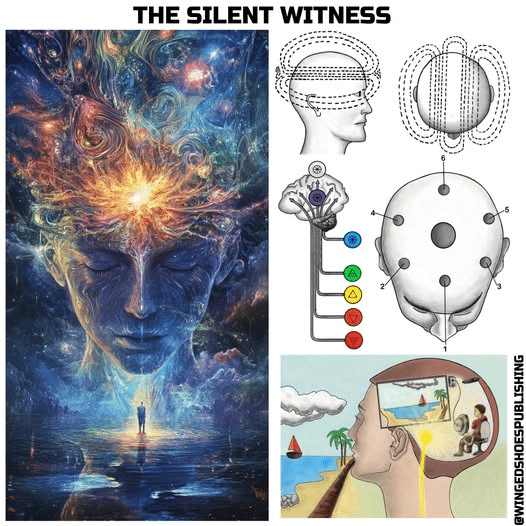
The witnessing awareness that notices our
thoughts, emotions, sense of self, and perceptions
is an unchanging mirror-like consciousness.
It merely reflects what arises and appears in experience.
The less reflection occurs in terms of mental events,
the more likely the mirror will experience its own pure and unchanging clarity.
The more powerful that the mental projection of a sense of me is,
the mirror’s own intrinsic clarity is less noticed.
So it may be necessary at first
to reduce the volume and intensity of the reflections
before introducing the observing nature of the mirror itself.
However,
the best means of reducing the reflections, i.e.,
thoughts, stories, and negative emotional states,
is by being a witness to mental events as they arise,
thus
creating some psychological space between the thoughts and the observing awareness.

Ultimately we need to realize that the imagined self does not exist.
That sense of self is just a label and a sensation that your mind is creating
in reference to your body and experience.
It’s like when in a darkened room you see a rope on the floor.
The mind thinks it’s a snake and the thought “snake” appears.
Next adrenalin is released.
The mind has applied the label “snake” to the rope.
There is no snake… yet the entire body and mind react as though there is.
Likewise,
the mind creates the notion of a self,
an “I,” in regard to the body and mind,
just like the label “snake” was applied to the rope.
But if we really examine this I thought and sensation closely,
we won’t find anything concrete that corresponds to this self idea
as being real.
It is important to remember always that the principle of egolessness
does not mean that there was an ego in the first place…
On the contrary,
it means there was never any ego at all to begin with.
To realize this is called “ego-lessness.”
(Sogyal Rinpoche, Tibetan Buddhist teacher)
We experience a 3-D image of what the mind thinks is “out there.”
It’s a picture in our head. The eyes can’t see any better than your toes.
Eyes are passive receivers of light photons. They don’t see anything.
All those electro-chemical signals are figured out in the brain
where a 3-D image is constructed along with a viewer of it.

That “viewer of it” is also the mind’s projection of
an implied self at the center of experience.
Without the mind creating that sense of a centralized self,
there would be no sense of there being a self that is having experiences.
There would just be experiences happening to no one,
yet the vivid knowing of all experience would be sheer delight
as there would be direct perceptual experience without any filters.
This would be the same as when we were young children.

Question:
You say, “Without a doubt, you are that unceasing Light of Awareness.”
I have doubts. How can I come to know that I am that Light?
Answer:
That is the purpose of this book:
to provide instructions for that realization.
The priority is to recognize the awareness
that knows your thoughts, feelings, perceptions, and all experience.
Notice how your awareness remains unchanging,
but what it observes is in constant change.
The scenery is always new,
but the observingness is always the same.
The more you are simply attentive to your perceptions
without adding mental content regarding them,
the more familiar you become with this naked perceiving or observing.
Sometimes when sitting,
just notice your surroundings without judgment or mental commentary.

Do the same when taking a walk, particularly in natural surroundings,
and just silently observe.
From time to time,
notice this quality within your consciousness of thought-free observing.
As you gain a subtle ability to discern your own observing awareness, it may become obvious that

.
You are that sphere of clear light that is aware and perceiving.
You seem to be centered in your skull looking out your eyes
and listening through your ears.
As your mind becomes more clear and silent,
the fact of being an aware presence becomes apparent.
That which is looking out your eyes at these words
is that changeless aware presence.
Look back at that which is looking.
As your consciousness and attention become ever more settled in this
condition of naked observance,
insights into the nature of your awareness arise spontaneously.
This is the beginning of the Light manifesting in consciousness,
the Clear Light of Awareness, your true nature.