Integration:
The Merging of Wisdom, Love, and Life –
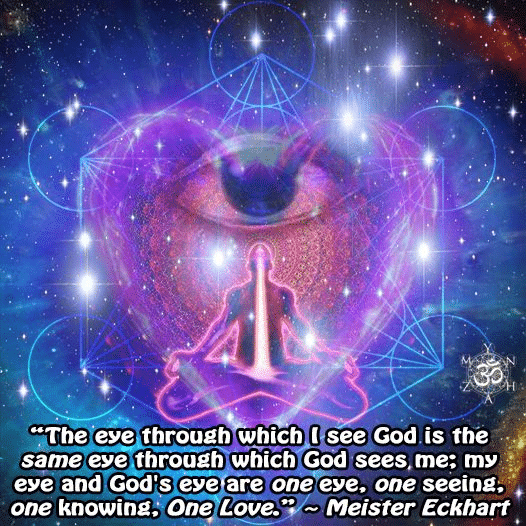
The eye through which I see God is the same eye through which God sees me;
my eye and God’s eye are one eye, one seeing, one knowing, one love.
— From the Sermons of Meister Eckhart
We can only discuss being and awareness up to a point.
That point is when our mind becomes oriented into resting as
an attentive and alert presence that is totally relaxed.
We have no topic in mind. We are just being and observing,
not thinking about or judging our experience.
Everything is allowed to be as-is, internally as thoughts, feelings, and perceptions,
and externally as events and happenings.
Let’s be.
When we accrue some proficiency in this,
a clear state of awareness spontaneously arises.
As this clarity deepens, a sense of knowing who and what you are spiritually also arises.
Leaving this as-is, the sense of being an observer dissolves,
and there is a perfect non-dual integration of awareness and its field of perception.
This is sensed as oneness.
Again you just leave this condition of oneness as-is,
and even it yields to a further condition of indescribable, vivid transparency,
as though you are
.
The five senses are open and alert but with
no sense of someone seeing and hearing.
There is just a naked seeing, hearing, feeling, and perceiving.
The mind is completely still in clarity and presence,
yet totally relaxed.
One then continues in this natural equipoise without effort or will.
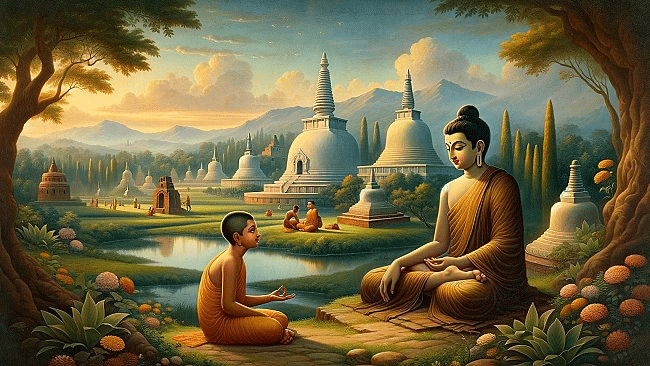
The Buddha was approached and asked by a person named Bahiya
to reveal the insight necessary to realize enlightenment:
“Teach me the Dhamma (supreme truth) , O Blessed One!
Teach me the Dhamma, O One-Well-Gone,
that will be for my long-term welfare and bliss.”
The Buddha responded:
“Then, Bahiya, you should train yourself thus:
In reference to the seen, there will be only the seen.
In reference to the heard, only the heard.
In reference to the sensed, only the sensed.
In reference to the cognized, only the cognized.
That is how you should train yourself.
When for you there will be only the seen in reference to the seen,
only the heard in reference to the heard,
only the sensed in reference to the sensed,
only the cognized in reference to the cognized, then, Bahiya,
there is no ‘you’ in terms of that.
When there is no ‘you’ in terms of that, there is no ‘you’ there.
When there is no ‘you’ there,
you are neither here nor yonder nor between the two.
This, just this, is the end of samsara (suffering).”
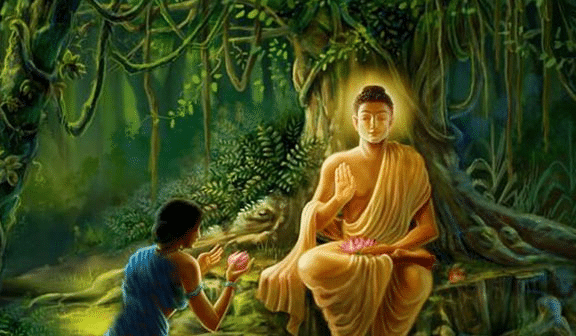
This is the Buddha’s teaching regarding simply to allow
seeing, hearing, tasting, smelling, feeling and cognizing
to occur without thoughts and stories intervening,
including without the subtle thoughts of
I am seeing, I am hearing or I am thinking.
One is also not engaging thoughts with more thoughts,
but just noticing a thought appearance like any sensory perception.
There is no sense of “I am thinking” or “my thoughts”.
Thoughts just appear, owned by no one as they come and go.
Just nakedly perceive without a center point of self-consciousness,
as a newborn infant would experience its world.
~
If and when the mind arises with its grasping tendency again,
as the central viewpoint of subjective experience as I am,
you may feel separate from the total perceptual field.
If you relax that grasping, the state integration will arise once again.
This is the art of our practice. This subtle art continues until
the mind no longer attempts to grasp the experience intellectually
or worries about how to maintain the holistic integration
and keep it from going away.
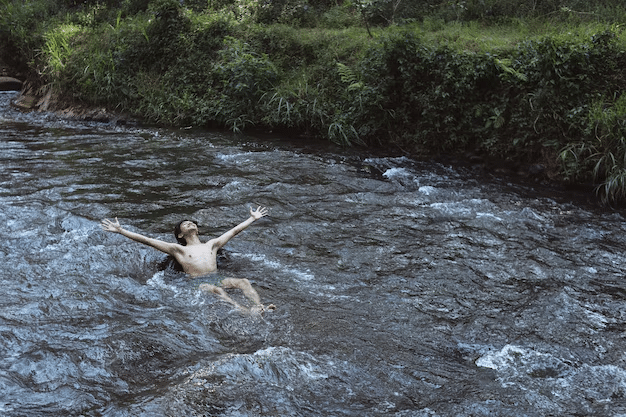
Imagine you are in a river, flowing with the stream
in a most comfortable and playful frame of mind.
Suddenly you are standing on the beach alone, shivering and wet.
You wonder how this happened.
You can’t figure out how to simply jump back in the water.
You are now a spectator on the sidelines.
Our natural condition is oneness flowing in total integration as the river.
Through the action of the mind’s grasping energy,
the subject-object dichotomy arises.
In this instant consciousness assumes a specific vantage point.
It becomes self-conscious and perceives the world of experience
but as though separate from it.
When we feel this separateness, which leads to a sense of fragmentation,
suffering of some sort is sure to follow, and our spiritual quest,
the return to oneness, begins.
Through our practice and insights,
we may come to a clear intuitive knowingness of aware being.
~
But now we can ask, “what is being doing”?
Our life is not just living in a static state removed from movement and activity.
We have bodies that are constantly doing things in the world.
Where do the realms of being and doing meet?
Is it possible to be fully integrated within our doingness?
I would like to suggest that we experience this integrated state daily during our doing, and more often in our doing than in our moments of stillness.
We think we have to sit in our meditation posture in perfect stillness
to realize oneness or enlightenment.
We miss the moments of perfect oneness that arise throughout our day
because during those moments we are in oneness.
When you are truly in it, oneness is not noticed.
Otherwise you would be outside oneness looking at it.
A good analogy might be concentrating on an activity
in which you are fully engaged in, whether it’s a sport, an artistic endeavor,
making love, or washing the dishes.
You are one with the action, the doingness, when fully engaged.
You completely forget yourself in the doing.
This is authentic oneness.
This is why many Zen masters have advocated physical labor or cleaning
as a good Zen practice.
You become totally one with your activity.
This is the purpose of all the Zen aesthetic and martial arts,
like brush painting, tea ceremony, flower arrangement, kendo, Zen archery,
and aikido, to mention the most well known of Zen arts.
The practice is to come to a state devoid of all self-consciousness,
which happens to be the purpose of Zen meditation.
So there is another way to discover this original state of oneness
outside of sitting meditation practice.
To discover oneness through an activity is even more powerful in life.
Then all that you are doing is your practice.
In recent years,
this pleasurable total absorption in our daily activities has been called
“flow” or “being in the zone.”
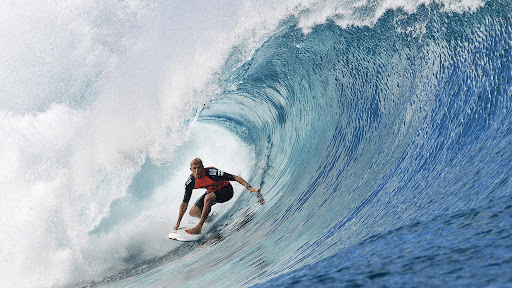
It’s not a deliberately focused mindfulness, as we may be too self-conscious
in order to forget ourselves completely in the action.
To study Buddhism is to study the self.
To study the self is to forget the self.
To forget the self is to be enlightened by all things.
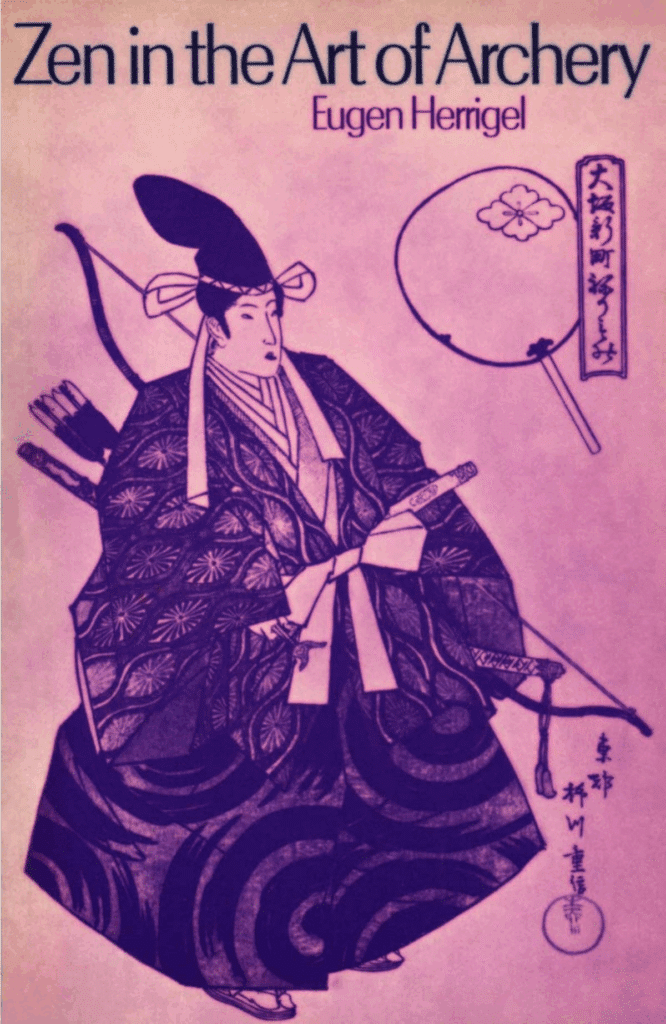
In his book Zen in the Art of Archery,
Eugen Herrigel documents his experiences training under a Zen master
who was also a master of kyudo, the art of archery.
Herrigel learned that one needs to remove the personal self
and all intentional will from an action in order for the
ultimate consummation of execution to occur.
Once it occurs,
the action seems to happen on its own.
One discovers a “higher power” within yet beyond oneself.
The higher power conducts the activity without interference from personal volition.
The master referred to this higher power as It.
He would say things like, “Let It conduct the activity.”
ideally,
a spontaneous action would arise of itself and the result would be quite perfect.
The point is that there is certainly a higher power at work that,
if not personally interfered with, can accomplish great things effortlessly.
There is something formlessly created Born before Heaven and Earth So silent!
So ethereal!
Independent and changeless Circulating and ceaseless It can be regarded as
the mother of the world.
I do not know its name Identifying It,
I call It “Tao” Forced to describe It, I call it Great …” .
( Lao Tzu )

If we can live our lives completely free of self-consciousness in all that we do,
our life flows harmoniously and brings benefits of joy and satisfaction.
Being free of self-consciousness is the same as absence of ego.
The ego’s energy transforms into the
pure clarity of attentive action in total nowness.
This does not mean that we need to be engaged in activities of a
religious or spiritual nature or in a humanitarian endeavor.
Any activity that brings a sense of pleasurable engagement
in total absence of self-consciousness will do.
It could be as mundane as washing your car, engaging in a sport,
hiking in compelling scenery, or making love.
Whatever it is,
it requires that one be totally absorbed in the action,
yet in a context free of pressure or duress.
Once these moments are savored,
it is possible to bring this attentive and naked presence unconsciously to all that we do.
The key is to bring the activity to a point of total absence of self-consciousness.
And it is not wise to “check out”
if you “feel” the absence of self-consciousness during the action;
that is tantamount to becoming self-conscious
to see if you are free of self-consciousness.
Remember,
when ego as self-consciousness transforms into the cognitive energy of the activity,
no inner witness notices the quality of the performance.
Most often, an indicator that a moment of absence of self-consciousness has occurred
is a cognitive time distortion.

People often ask after such experience,
“Wow, where did the time go? ”
It was a timeless moment because without the ego as self-consciousness,
there is no time.
People have moments outside of time in total oneness
and absence of self without having studied, meditated,
or thought about such topics previously!
Becoming cognitively alert to these moments of oneness,
you begin to notice the subtle and delicate quality of the flow,
like the flow of the Tao.
You live in the flow as being the flow, in whatever you do.
As you learn to live in the natural flow of life, absent of self-consciousness,
the orientation begins to shift from awareness
to becoming grounded in your own heart of compassion and intimate caring.
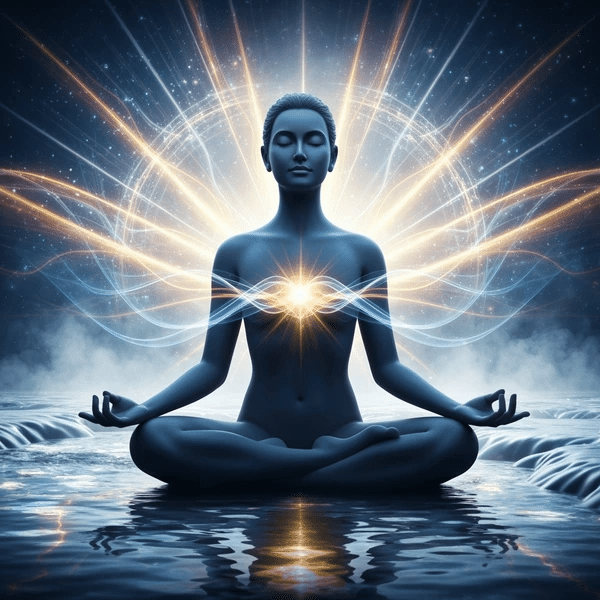
From the brilliant clarity of sight and sensory experience centered in the head,
your center of consciousness descends into the depths of the heart,
where you find peace, contentment, love, and joy.
These qualities of the heart aren’t the result of attainments or virtuous actions,
rather they are intrinsic to your very Being.
By simply inviting your consciousness into the heart,
you come to know your most intimate nature.
You discover your reason to live, your purpose for being.
There is divine wisdom, peace, and stillness in the heart
that only awaits your conscious arrival.
Many traditions have spoken of this wisdom and of the heart
as the seat of divinity in man.
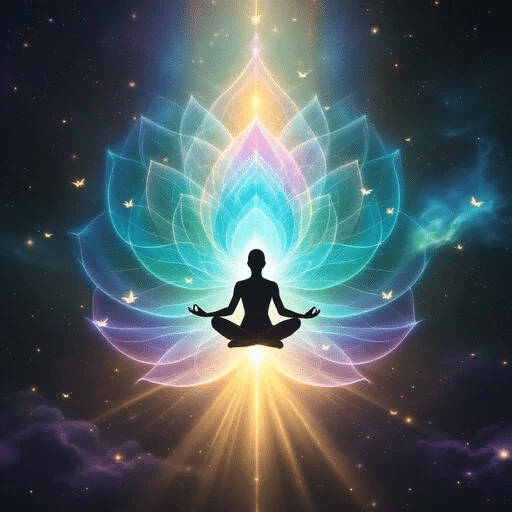
The Self is hidden in the lotus of the heart.
Those who see themselves in all creatures go day by day into
the world of Brahman hidden in the heart.
Established in peace, they rise above body-consciousness
to the supreme light of the Self.
Immortal, free from fear, this Self is Brahman, called the True.
Beyond the mortal and the immortal, he binds both worlds together.
Those who know this live day after day in heaven in this very life.
( From the Chandogya Upanishad, 8 : 1.1 2 4.3 .
Translated by Eknath Easwaran in The Upanishads
(Petaluma , California : Nilgiri Press , 1987 ) .
Rumi the thirteenth – century Sufi mystic wrote:
Only from the heart can you touch the sky.
As you live Deeper in the Heart, the Mirror gets clearer and cleaner.
I searched for God among the Christians and on the Cross
and therein I found Him not.
I went into the ancient temples of idolatry; no trace of Him was there …
Finally, I looked into my own heart and there I saw Him;
He was nowhere else.
~
From the Eastern Orthodox Christian tradition:
You’ve got to get out of your head and into your heart.
Right now your thoughts are in your head, and God seems to be outside you.
Your prayer and all your spiritual exercises also remain exterior.
As long as you are in your head, you will never master your thoughts,
which continue to whirl around your head like snow in a winter’s storm
or like mosquitoes in the summer’s heat.
If you descend into your heart, you will have no more difficulty.
Your mind will empty out and your thoughts will dissipate.
Thoughts are always in your mind chasing one another about,
and you will never manage to get them under control.
But if you enter into your heart and can remain there,
then every time your thoughts invade,
you will only have to descend into your heart
and your thoughts will vanish into thin air.
This will be your safe haven.
Don’t be lazy. Descend. You will find life in your heart.
There you must live.
Attention to that which transpires in the heart and proceeds from it —
this is the chief activity of the proper Christian life.
( Quotes from the nineteenth – century Russian Orthodox monk
St . Theophan the Recluse )
When our consciousness fully enters the heart,
we notice a completely different experience of being.
The sense of separation is absent,
as all duality between an independent localized self-awareness
and our Absolute Beingness is resolved.
There is profound peace, settled-ness, and contentment.
When the mind eventually sinks into the Heart,
undisturbed bliss is overwhelmingly felt.
There is then a feeling which is not divorced from pure awareness,
as an example,
head and heart become one and the same.
( Ramana Maharshi , GR , 80 )
In this moment we feel our essential nature to be unconditional love,
a pure radiance of Being’s self-luster.
We don’t have to do anything to earn this;
it’s always been present eternally.
Through our engagement with our mind’s activities and distractions,
we haven’t bothered to notice our true nature.
As Jesus taught,
“ The kingdom of God is within you ”
( Luke 17 : 21 ) .
I was to visualize a golden Buddha in the center of my heart.
He was radiant and glowing with golden light.
From his heart center,
rays of light emanated outward in all directions,
bringing the energies of love and compassion to all sentient beings in the universe.
In order to accomplish this visualization practice,
I first had to generate the sense that at the center of the Buddha’s heart
resided an infinite power of love and compassion.
That power could relieve the suffering of all beings in the universe.
With that clearly in mind,
I visualized the outward streaming of this powerful light
reaching all ends of the universe.
As I remained with this visualization for several minutes,
suddenly it felt as though the center of my heart broke open
and an experience of total love flowed through my being.
I have never known such a deep feeling of pure love and compassion before or since.
This profoundly spiritual experience drove me deeply into
the innermost core of my existence where I discovered
the heart light of my true nature,
a guide that would never fail to lead me in the right direction.
~
~
Here is a very simple meditation that can offer a means for everyone
to enter their own inner sanctuary of the heart.
First,
find a quiet space or room for the practice.
Find a comfortable seat: sitting on a chair or on a cushion on the floor.
Align your posture so that your spine is straight.
Close your eyes and just notice your breathing for several minutes.
As you breathe in,
imagine the energy of your breath going into
the center of your heart chakra in the center of your chest.
Breathe gently like this while focusing on your heart chakra.
When your mental energy has settled down and you feel relaxed and open,
remember a time when you felt strong love for someone.
Once you have even the slightest feeling of love in your heart,
remain focused on that feeling.
Let that feeling grow and attract your attention more and more.
As you become proficient with this practice,
your attention and consciousness drift deeper into the space of the heart.
It will seem that your consciousness has descended
from being centered in your head to being located in your heart.
In this new condition you discover a deep peace. contentment, and loving joy.
You may also notice the sensation that the heart is like an aperture on a camera
that is now opening or dilating ever wider.
This is a good indication that your practice is moving in the right direction.
Continue with the exercise as outlined above,
and the rest develops spontaneously and organically.
If you like,
you may also engage in the practice I was taught in Nepal and described above.
But above all,
forget your thoughts and imagined stories,
and relax completely in this clear and aware heart space of your true nature.
You can realize that the heart has its own wisdom
and only fully comes to life when the dualistic thinking mind
is transformed into Clear Light.
~
The main job of the intellect is to assure strategic survival of the organism.
The main job of the heart’s wisdom
is to bring us home to our essential goodness, perfection, and joy.
We are beings of Light, and through recognizing our own awareness to be
the Clear Light of the Heart, we find we are already home.
Inspire yourself along this journey by opening your heart to love all beings and life.
Delight yourself in nature’s splendor and dance freely
in the Clear Light of your own self-recognition from moment to moment.
