
The Natural Bliss of Being – Jackson Peterson
What I (Jackson) discovered in my out-of-body experience was
the actuality of our subtle body,
a spiritual energy complex that exists as
the mind’s vehicle when the body dies.
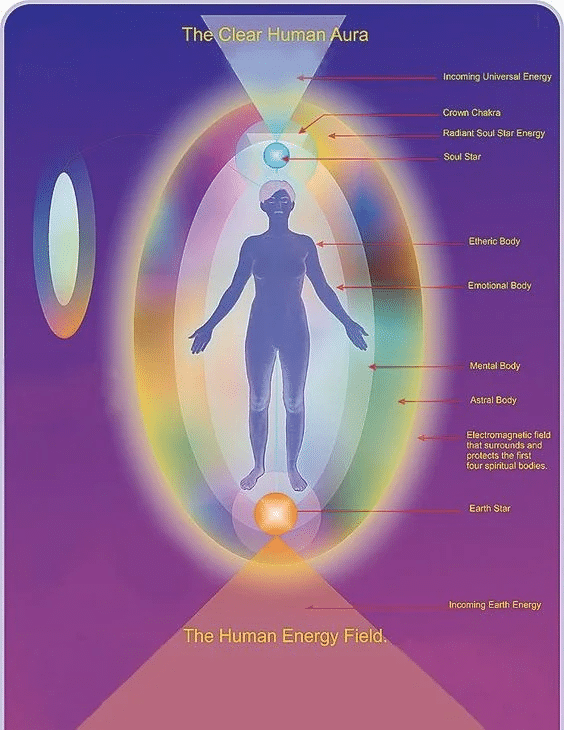
This complex of conscious energies is what is called
the soul in almost all religious traditions.
Some spiritual traditions consider the goal of spiritual life and practice
is to become one with God.
In Eastern traditions that has been expressed most overtly in Hinduism,
as the purpose of yoga.
Yoga means “union,”
union of the personal soul or self with God, Brahman, or Self.
Buddhism refers to this Self through a much less anthropomorphic term called
Nirvana.
At the end of Buddhist practice you realize that the localized self was an illusion,
a projection of mind.
You realize that your true nature is Nirvana,
a self-less state of pure Beingness,
and this Beingness manifests itself as an apparent localized self
that doesn’t know its own origin.
This is similar to the identity you appear to occupy in a dream
that doesn’t recognize its own self-identity as being
just a projection from a deeper source.
In this moment, notice ‘what is looking at these words.‘
This pure looking has no name, identity, or history.
It is your changeless Nature. Using the mirror analogy again,
consider the natural state of our beingness to be like a vast mirror.

All phenomena appear in it as reflections.
Our mental or cognitive experience is one of only
seeing, feeling, or noticing the reflections.
How can we see or know the mirror, our essential nature?
It’s just like when you stand in front of the mirror looking at your reflection.
You normally see the reflections only.
But if you have to clean the mirror, you shift your seeing so that
you are able to see the clear glass of the mirror instead of the reflections.
We can do something similar in meditation or by simply noticing our condition.
We shift our attention from being absorbed in our thoughts and images
to releasing and relaxing that attentive absorption,
and by so doing we are able to notice the vividness of our
always-present naked awareness.
That is how you notice the mirror of awareness.
Then as a practice, continue releasing, relaxing, and noticing our
vivid awareness again and again.
Remember to bring your attention and awareness to your eyes,
and notice the transparent nature of this clear seeing.
As the practice progresses,
notice how the releasing and relaxing becomes spontaneous.
The thoughts and images arise and release on their own.
Eventually even the slight effort required for
noticing the vivid awareness dissolves,
revealing vivid awareness to be our true nature
that spontaneously pervades every experience.
Coming to total realization is
recognizing the nature of your own being as pure awareness.
When we discover our awareness to be an impersonal consciousness
that is simply present as being,
we may recognize that this awareness is a universal consciousness,
the Ground of Being.
Some may call it the Mind of God, the Buddha Mind, or the Self.
Going forward, when we refer to this impersonal aspect of awareness,
we will differentiate it by capitalizing the first letter of Awareness.
Realizing universal Awareness is as simple as
noticing the immediate lucid presence that is reading these words
and recognizes the thoughts that arise about them.
The recognition that all thoughts are actually modulations of
the energy of Awareness is a primary insight.
All of these thoughts arise in the mind and
dissolve from moment to moment.
Thought is a wave-like vibration of conscious energy with informational significance.
Thoughts occur in awareness, like reflections in a mirror.
The mind is itself the creative energy of awareness
appearing in the energy forms of thought and imagination.
This energy field of the mind
surrounds this non-dimensional point of aware consciousness like an aura or,
when contracted, like a cocoon.
This is the subtle mental body.
The subjective experience of self-consciousness is its own energy field
centered around the ‘I’ thought.
In other words,
when the sky is filled with clouds or the mind is filled with thoughts,
we experience a cloudy day or a mentally absorbed moment.
The sky has not been altered by the presence of the clouds,
nor has awareness been altered by the presence of thoughts or mental content.
But regarding the mind,
the mental content is our experience in that moment.
So
Awareness doesn’t change, only its contextual content does.
Recognizing this unchanging aspect of awareness is a significant break-through
in terms of personal liberation.
The spacious emptiness of our observing mind and
its appearances in terms of thoughts both exist
in the same moment and at the same location,
like reflections appearing in the glass of a mirror.
The cognitive knowing of experience is a quality of
the aware emptiness or aware space.
Conceptual significance and energy intensity are the
defining aspects of the form of thought.
The empty awareness permeates the form of thought non-dualistically
as water does a wave.
Thought is a wave of awareness.
Recognizing the empty awareness present within all mental phenomena experienced,
such as a perception, feeling or thought, reveals the form to be
empty awareness at root and so it releases and transforms back into its
naked essence as awareness.
This is the method of self-liberation.
It’s not that we have to “do” something to “self-liberate” thoughts;
they automatically reveal their intrinsic impermanence moment to moment.
We simply take the position of
purely experiencing all perceived phenomena free of evaluation.
~
Notice how your naked-aware perceiving is changeless whether
thoughts, self-fixation, suffering, or pain arise.
Its mode is oneness with everything.
Its path is always leaving everything as-is.
What effort is there in noticing things exactly in the way you experience them?

The term Buddha means “the awoken one.”
From what did he awaken? He awoke from
the dream projection of the mind and its imaginary self or ego.
The dream is our mind’s story, which is made up of
thoughts, identities, imagination, and conditioning.
All suffering exists only in this story.
It is not that you are depressed,
it is only your ego or false-self that is depressed.
It is not that you are angry, it is only that your ego is angry, and so on.
That means that it is only your ego that suffers.
On the cessation of the dream of self and its story,
suffering ceases and you recognize yourself to be
undefined and unchanging Aware Being.
Aware Being is never asleep.
It’s aware during sleep, dreaming, thinking, in life and in death.
It’s just not usually noticed.
Aware Being knowing Itself is enlightenment.
~
Our true nature has no preferences, goals, plans, or problems.
It’s not enmeshed in a story.
It has no desires or thoughts.
It never becomes confused.
It has no sense of personal self.
It has no sense of possessiveness.
Yet
it empowers all that is into apparent existence in total spontaneity.
The only freedom to be found is in being fully awake to what you are.
Question:
Could you explain in more detail how by
realizing the emptiness of the perception, thought, or feeling,
it will release back into the awareness from which it arose?
Answer:
If during an experience of a thought or mental occurrence of any kind
we notice the empty quality of our observing awareness that is perceiving the thought,
the occurrence will diminish or dissolve.
By doing this we are actually realizing the empty or transient nature of the occurrence.
The occurrence, remember, exists in our consciousness.
The only objects that occur in consciousness are thoughts or mental perceptions
because the mind or brain creates a 3-D representation
from the “external” sensory input of which we then become “conscious.”
In other words,
external objects never appear in our consciousness,
only the mind’s representation of them.
For our purposes,
we could consider all objects that appear in consciousness to be waves of awareness,
as there is no separate substance that shows up in our mind
other than consciousness itself appearing as the forms experienced.
This is similar to saying that when we have a dream,
all the things and people that appear in the dream are made of dream “stuff”
or mental images.
That means that everything we experience in consciousness
is an aspect of consciousness itself and
consciousness as awareness is fundamentally a clear emptiness.
That means
the essential nature of our thoughts, feelings, or perceptions are also empty,
like the content of our dreams.

When we wake up in the morning,
we realize the absolute emptiness of our dream world.
It never had solidity of any kind,
but it seemed solid and real during the dream.
It was just a projection of mind.
Likewise,
our mental experiences that arise in waking consciousness
have no actual substance either.
It is this recognition of the
emptiness of our thoughts, mental events, and sense of self
that liberates us from our dreamlike world of suffering and anxiety.
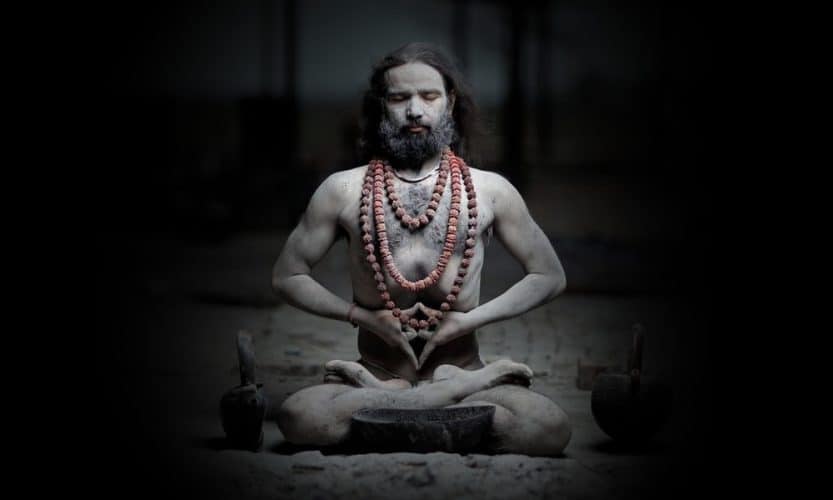
In the meditative traditions, this state of non-localized being
is experienced in what is called samadhi, which is
a non-dualistic state of consciousness where
the Oneness of Reality is directly known.
For most contemplative traditions,
this state occurs by perfecting the practice of meditation.
In this meditation,
the mind is encouraged to become perfectly
still through concentration and breathing exercises.
At some point the mind may come to perfect stillness,
meaning all thoughts have stopped and the sense of being a separate self,
which was just made up of thoughts, dissolves.
If we do manage to still the mind,
there remains an awareness that notices the stillness.
That awareness is the same one that notices thoughts and perceptions.
It is never in a dualistic condition in relationship to its experience.
It has no personal sense of self.
It doesn’t think or imagine.
Yet it is always the presence of our undefined, conscious awareness.
However,
there is a less well-known way of accomplishing samadhi
without meditation practices and efforts to still the mind.
By simply relaxing one’s thinking mind into being
a nonjudgmental observing presence,
the mind naturally collapses into the stillness that is
the essential nature of this observing awareness.
At that point the energy of the mind is in the naked condition of attentive alertness,
instead of active thought.
By continuing in this naked perceiving,
the awareness itself reveals its own inner dynamics
and a natural state of non-dual samadhi is revealed, not created.
~
This is the method that I am sharing in this book
as the essential means to recognizing the already enlightened nature of mind
that resides within and as the core of our existing consciousness.
From the out-of-body experience (Jackson had) in Denmark,
I knew that this witnessing consciousness was independent of the body and brain.
I also perceived that it has no material substance, is clear and transparent,
yet vividly alert and aware.
And most importantly I realized this awareness to be
the essential nature of my own existential presence.
Through various methods it is possible to further realize the full potential and
nature of our ever-present awareness.
We also discover that we are not just passive witnesses of experience and life.