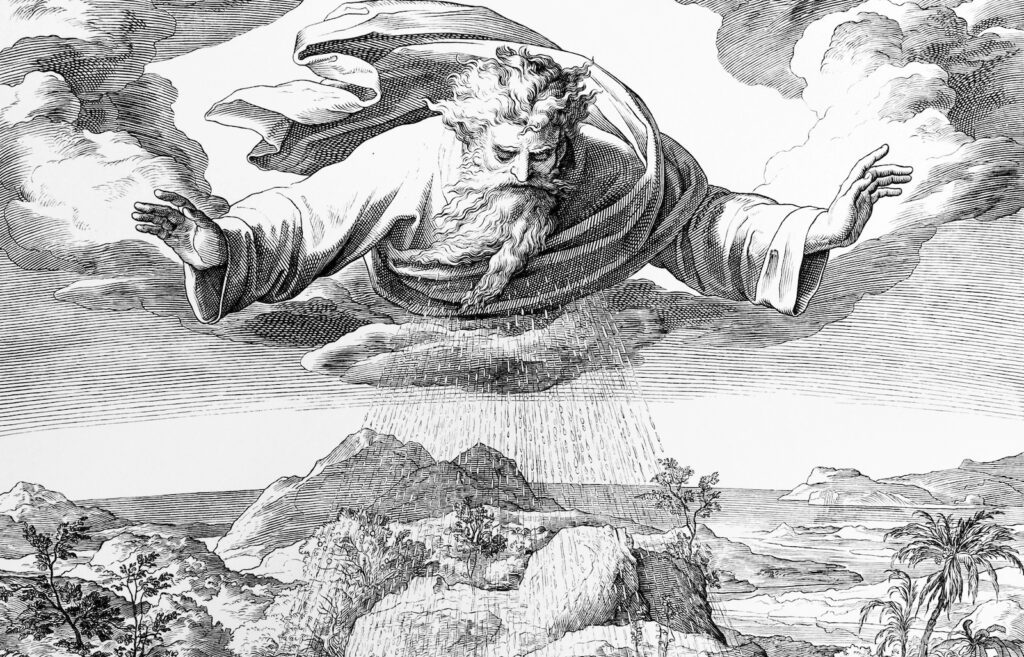
“If God and Jesus are “up there somewhere,” hovering above the wreckage like cosmic spectators, then stop pretending Christianity has anything meaningful to say to this world. A God who lives at a distance is functionally useless. A salvation that’s always *later* is just religious procrastination. “Jesus will come back and fix it someday” is not hope—it’s abdication of responsibility dressed up as faith.
And let’s be honest: Jesus already came once. If the plan was for his physical presence to magically straighten out humanity, then the plan failed. Empires kept crushing the poor. Violence kept reproducing itself. Religion kept cozying up to power. If anything, Jesus’ first appearance exposed the mess—it didn’t clean it up. Which should tell us something, if we’re willing to think instead of just repeat doctrine.
Jesus never claimed to be the lone savior swooping in to rescue a helpless species. That idea came later, constructed carefully by religious institutions that needed control, certainty, and a reason you should keep showing up and paying attention. What Jesus actually did was far more threatening: he embodied a way of being that revealed where transformation really happens. Not in the sky. Not in the future. Not through correct beliefs. But *within*—in consciousness, in love, in how we show up for one another.
Christianity’s catastrophic error was confusing the *pointer* for the *point*. It took a living, breathing invitation to awakening and embalmed it into a belief system. It obsessed over Jesus’ body—where it came from, what happened to it, and when it’s coming back—while ignoring what his life was exposing about our own. The gospel was never “worship me so you don’t have to change.” It was “wake up—you are capable of this life too.”
The doctrine that Jesus was both divine and human was never meant to shut the conversation down. It was meant to blow it wide open. It wasn’t a metaphysical trivia question. It was a confrontation: *If divinity can live fully in humanity, what excuse do you have for staying asleep?* But religion flipped it. Instead of seeing Jesus as a mirror, it turned him into an exception. Instead of an invitation to maturity, it became permission to remain dependent, passive, and spiritually infantilized.
I know how this plays out, because I lived it. I tried to save the world the Christian way. I told people God loved them. I preached grace. I explained salvation. And almost nothing changed—except maybe people felt temporarily reassured while continuing to live exactly the same lives. That’s when I realized something no sermon prepared me for: words about love are cheap. Theology is safe. Belief is easy.
So I stopped trying to save anyone. I stopped announcing God. I stopped explaining Jesus. And I started doing the one thing religion loves to talk about but rarely practices—loving people without conditions, without leverage, without an agenda to fix or convert them. No altar calls. No manipulation. No spiritual transactions.
That’s when things actually began to shift.
Here’s the truth religion doesn’t want to face: the world doesn’t want to be saved. It’s tired of being someone’s project. What the world wants—what it’s starving for—is to be loved. Not abstractly. Not spiritually. But concretely, embodied, right here in human flesh and human presence.
Waiting for Jesus to return is easier than becoming what he revealed.
Worshiping him is safer than following him.
Believing the right things is far less threatening than loving recklessly.
But if Jesus meant anything at all, it’s this: salvation doesn’t descend from the sky. It emerges from within us. And until that truth takes flesh again—in you, in me, in how we live—Christianity will keep talking about hope while the world keeps bleeding.
That’s not rebellion against the gospel.
That’s rebellion *for* it.”
– Jim Palmer, Inner Anarchy
Read IA here -> https://tinyurl.com/y8zaxcmr

Regardless if one believes Jesus literally lived in this world in the flesh as a human…
Or
If one takes to heart the story of the man… metaphorically.
You don’t need a middleman… a religion or church
to tell you what and how to experience ‘God, Grace and Divinity’.
The middleman will only be a diversion from the
fulfilling personal experience of ‘God, Grace and Divinity’…
A personal spiritual path based on all the ‘non-theological’ traditions
or at least as many different perspectives one can integrate into
a ‘whole-some’ understanding of the ‘ineffable’ nature of our own True self
and
how that is inseparable from what is projected to be “God, Grace and Divinity.”
The middleman of religions will only add their
biases, projections based on outdated strict rituals, doctrines and dogmas…
This will only become a distraction at best, but typically…
A dead end to personal spirituality.
————————–
Those so inspired to experience Spirituality
instead of believing what someone tells you to believe…
This is a good start:
Inspiring Spiritual Insights:
Begin Your Journey of Awakening!